

There is a particular kind of organisational failure that does not come from being surprised. It comes from being warned — clearly, repeatedly, over years — and choosing not to act. Dean Van Leeuwen, Chief Exploration Officer and Founding Partner at TomorrowToday Consulting, has a name for this failure mode: grey elephants. Unlike black swans, which are genuinely unpredictable, grey elephants are massive, slow-moving forces that are visible to anyone paying attention. They are not hidden. They are ignored.
Van Leeuwen brought this framework to the Horizon Summit 2025 in Amsterdam, where he challenged HR professionals to confront seven of these forces head-on — and to understand that the window for proactive preparation is narrower than most organisations realise. The future of work trends shaping the next decade are already in motion. The question is whether HR leaders will engage with them deliberately or wait until they are unavoidable.
What Are the Seven Grey Elephants?
Van Leeuwen identified seven major forces that sit at the intersection of high probability and high impact — yet consistently fail to make it onto most organisations’ strategic agendas until they arrive as emergencies.
Aging populations. People born in the 1990s may live to 125 years. The implications for careers, retirement structures, intergenerational dynamics, and benefits design are profound, and virtually no HR function has redesigned its frameworks to reflect them. The OECD Employment Outlook 2025 projects the old-age dependency ratio will reach unprecedented levels across member countries over the next 35 years, warning that without swift changes in policy and workplace design, GDP per capita growth will slow significantly across most economies.
Intelligent advances. AI and automation are reshaping work at a pace that has outrun most organisations’ planning cycles. The risk Van Leeuwen highlighted is not AI itself — it is the tendency to focus on technology in isolation rather than on human-machine collaboration. Organisations that treat AI as a replacement story rather than an augmentation story will make expensive mistakes in both directions.
The angry planet. Climate change, pandemic risk, pollution, and antibiotic resistance are operational realities that affect supply chains, workforce mobility, and organisational resilience. Companies that built pandemic preparedness before 2020 navigated it better. The same logic applies to every force on this list.
Big squeezes. Strategic scarcity across talent, supply chains, healthcare systems, and natural resources is structural, not cyclical. Talent scarcity will not self-correct when economic conditions shift. HR functions that treat it as a temporary market condition are planning for the wrong reality.
Multipolarity. The shift of global power away from Western dominance toward competing power blocks is reshaping trade relationships, regulatory environments, and the geopolitical context in which global workforces operate. HR functions cannot treat geopolitics as someone else’s problem.
Societal fractures. Trust in institutions — governments, media, employers — is eroding across most developed economies. The 2025 Edelman Trust Barometer, which surveyed 32,000 adults across 28 countries, found that employer trust fell for the first time in the study’s 26-year history — and that nearly 7 in 10 people now believe business and government leaders purposely mislead them. With an estimated 3.5 billion more people expected to move to cities by 2050, urbanisation is compressing these tensions further. The social contract between organisations and employees is being rewritten whether HR is at the table or not.
Rising rage. Unprecedented levels of stress, economic inequality, and social anger are reshaping what employees demand from the organisations they work for. This is not a wellbeing trend in the conventional sense. It is a systemic force that requires a structural response, not a pastoral one.
Why HR Must Lead — Not Finance, Not IT
One of the sharpest arguments Van Leeuwen made at the Horizon Summit was about ownership. These seven future of work trends are fundamentally people challenges. They affect how humans live, age, learn, trust, and adapt. Yet in most organisations, the response to macro-environmental forces defaults to finance — through scenario planning and risk registers — or to IT, through technology investment. HR sits downstream, reacting to decisions made elsewhere.
Van Leeuwen’s argument was that this is precisely backwards. If aging populations will require entirely new career architectures, who should design them? If AI integration will reshape roles and require mass reskilling, who should lead that programme? If rising rage and societal fractures are destabilising employee trust, who has the expertise and the mandate to address them? The answer in each case is HR. Not as implementers of someone else’s strategy, but as the function that owns the people dimension of macro-level change.
The Bionic Organisation: Beyond the Automation Debate
A second major theme from Van Leeuwen’s session was the concept of the bionic organisation — and it cuts directly against the framing that dominates most discussions about AI and organisational change.
The automation debate tends to be binary: jobs replaced versus jobs created, humans versus machines, technology as threat versus technology as opportunity. Van Leeuwen’s argument was that this framing is itself the problem. The organisations that will navigate the next decade most effectively are not those that automate the most, nor those that resist automation the longest. They are those that deliberately combine human and machine strengths to create what he called superhuman performance — outcomes that neither humans nor technology could achieve alone.
This has direct implications for how HR functions think about workforce design, role definition, and capability development. Creativity, empathy, ethical judgement, and adaptability are human strengths that AI amplifies rather than replaces when the integration is intentional. Speed, data processing, consistency, and pattern recognition are machine strengths that free human capacity when properly deployed. The bionic organisation is one where these strengths are consciously combined rather than accidentally colliding. McKinsey’s 2025 workplace AI research found that while 88% of organisations now use AI in at least one business function, most remain at the experimenting or piloting stage — with limited enterprise-level results to show for it. The gap between deployment and value creation is, in large part, a people and culture problem.
For HR leaders, the practical question Van Leeuwen posed was a useful diagnostic: are we using AI to do the same work faster, or are we fundamentally rethinking how this work should be done? The former is efficiency. The latter is transformation. Most organisations are achieving the former while telling themselves they are doing the latter.
From Awareness to Action: What HR Leaders Need to Do Now
The grey elephant framework is not a call to panic. It is a call to earliness. Van Leeuwen’s core message was that the competitive advantage in navigating these future of work trends belongs to organisations that build their radar systems before the forces arrive in full force — not those who respond fastest once the crisis is visible to everyone.
The first practical step is establishing a grey elephant radar: a structured, quarterly review process in which cross-functional teams track weak signals across all seven forces and assess their relevance to the organisation’s people strategy. This is not a one-time horizon-scanning exercise. It is an ongoing discipline that keeps macro forces in peripheral vision rather than allowing them to become blind spots.
The second is redesigning career and retirement models for longevity. With people potentially working well into their seventies and eighties, the linear career model — entry, progression, retirement — is already obsolete for a significant portion of the workforce. Multi-stage career frameworks that accommodate continuous learning, lateral movement, phased transitions, and intergenerational collaboration are not a future requirement. They are a present one.
The third is building what Van Leeuwen called change ignition capability — the organisational muscle to drive meaningful transformation with clarity of direction rather than incremental drift. This requires unambiguous end goals, leaders who can hold a compelling vision while remaining genuinely open to how the path there evolves, and the ability to break overwhelming challenges into actionable pieces within each team’s sphere of influence.
The fourth is positioning HR as the central driver of these conversations. Not the team that produces the people slides in someone else’s strategy deck. The function that brings the human dimension of macro-level change into boardroom discussions before those conversations are dominated by cost and risk framing alone.
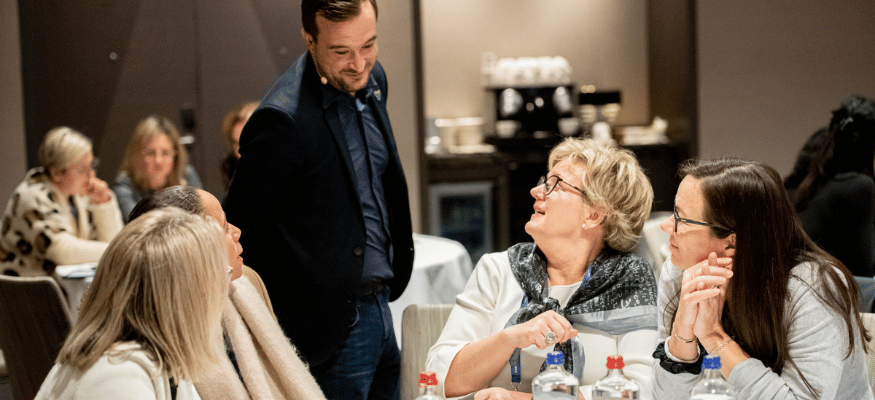
A year on, none of these seven forces have slowed down — if anything, several have accelerated faster than Van Leeuwen forecast. Horizon Summit 2026 picks up where the 2025 masterclass left off, moving the grey elephant framework out of stage debate and into structured peer exchange and tabletop discussions, where delegates work through the same seven forces against their own organisational realities. Where 2025 was about naming the elephants, 2026 is about testing what HR leaders have actually done since.
The Stampede Is Already Starting
Aging workforces, talent scarcity, AI disruption, societal fracture — none of these are surprises. They have been visible and trackable for years. The question is not whether they will reshape organisations. It is whether HR leaders will be the ones who shaped the response, or the ones who were shaped by it.
The grey elephants are already moving. The only strategic question is whether your organisation is dancing with them — or standing in their path.
The Horizon Summit 2026 returns to Amsterdam on 10–11 November, bringing together senior HR leaders to continue exactly these conversations — with the rigour, peer-level candour, and strategic depth that questions of this scale demand.