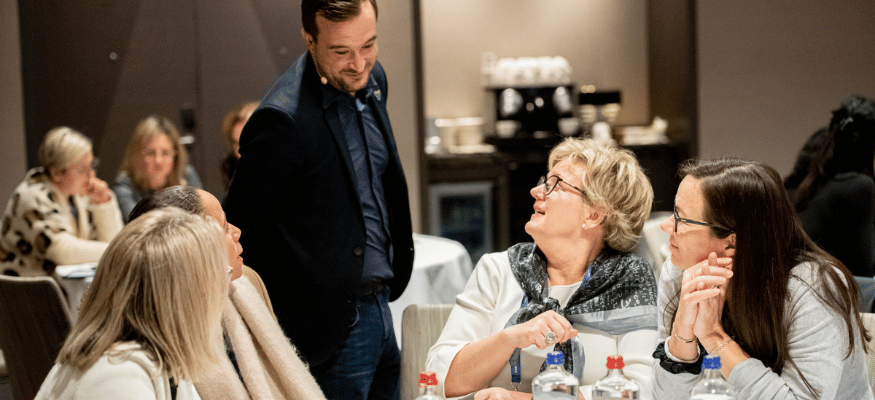


Any conference for HR leaders is only as valuable as the ideas it forces you to rethink. At last year’s Horizon summit in Amsterdam, one track did exactly that — challenging a core assumption most organisations still operate under: that culture is something you define at the top and roll out uniformly across the business.
This approach is fundamentally broken. Culture is not a single, organisation-wide phenomenon. It is a collection of microcultures in organisations — distinct patterns of energy, behaviour, and trust that vary from team to team, floor to floor, and office to office. What works in your Amsterdam headquarters may actively fail in your São Paulo office. What motivates your engineering team may alienate your sales floor.
For HR leaders who have spent years designing company-wide culture programmes and watching them land unevenly, this reframing is both uncomfortable and liberating. The sessions offered not just a diagnosis but a practical alternative.
Why Traditional Culture Programmes Keep Failing
Marinda Van Harskamp, a finance transformation consultant specialising in leadership, health and wellness, opened the track with a blunt assessment. Most organisations are trapped in a cycle of annual surveys, action plans, improvement programmes, and measurements that yield minimal tangible results. There are “many meetings, but little movement.” Leaders and employees alike are exhausted from being over-surveyed and under-served.
The root problem, she argued, is that traditional top-down culture programmes treat culture as something abstract and static — a set of values printed on a poster, a score on a dashboard. But culture is neither abstract nor static. It is what Van Harskamp described as an invisible yet tangible “flow of energy” that constantly moves between stuck and flowing states. And critically, that flow varies across different teams and departments within the same organisation.
This is the core insight behind microcultures in organisations: a single company does not have one culture. It has dozens, sometimes hundreds, of microcultures shaped by local leadership behaviour, team dynamics, workload pressures, and interpersonal trust. A company-wide engagement score of 72% might mask the reality that one team is thriving at 90% while another is collapsing at 40%. Averaging those numbers and responding with a generic programme serves neither team.
From Coaching Culture to Culture Coaching
Van Harskamp’s solution was a deliberate inversion: moving from large-scale “coaching culture” programmes to what she called “culture coaching” — a micro-level, practice-based approach that works with the grain of how culture actually operates.
The shift involves four practical moves that HR leaders could take back and implement. First, moving from increasing control to increasing awareness by tracking energy flow through regular conversations. Second, shifting from silence to dialogue by encouraging open discussions about what is and is not working at the team level. Third, leaders evolving from telling to translating — creating ownership through reflection rather than compliance through instruction. And fourth, measuring movement rather than maturity, meaning organisations track behavioural changes and energy flow rather than abstract culture scores.
The method is disarmingly simple. Leaders regularly ask their teams three questions: What went well? What felt heavy? Are you okay with it? This shifts culture work from annual surveys to continuous, real-time dialogue. The framework measures tangible behaviours — trust, autonomy, connection, reflection, and consistency — rather than sentiment. If any one of these elements drops to zero, flow stops entirely.
The result is that teams can address cultural stagnation immediately rather than waiting for the next corporate programme. Culture becomes something leaders do daily, not something HR delivers annually.
Microcultures During Mergers: The SWECO Case
If Van Harskamp provided the theory, the SWECO case study demonstrated how microcultures in organisations become a critical business variable during mergers and acquisitions — the moment when culture clashes are most expensive and most predictable.
SWECO, a 23,000-employee European engineering firm, has completed over 160 acquisitions since 1997 — roughly one per month. The industry data is stark: research consistently shows that 70–90% of acquisitions fail due to poor integration. SWECO needed a method to maintain culture coherence while absorbing diverse organisations at speed.
Helene Hasselskog – CHRO at SWECO and Mark Wybenga – HR Director at SWECO (Netherlands) talked about an approach centred on four principles. First, strategic management alignment before any deal closes — ensuring acquired leadership is fully committed to SWECO’s decentralised model, where 1,700 teams own their own P&L. Second, cultural due diligence conducted during the evaluation phase, not after — examining ownership structure, business culture, and decision-making styles to anticipate friction. Third, radical transparency with acquired employees about what will change, including helping people who do not fit find alternatives elsewhere. Fourth, immediate operational integration — involving acquired employees in joint projects and demonstrating tangible benefits early.
In the Netherlands alone, where SWECO completed ten acquisitions over three years, turnover among acquired employees remained at just 12.7% — only marginally above the company baseline of 10%. Full integration was achieved in 2.5 years. The human capital that motivated each acquisition was preserved rather than lost to culture shock.
The Three-Tiered Architecture for Global Organisations
A follow-up question that haunts every multinational is: how do you balance global consistency with local cultural needs?
The answer is a three-tiered framework for culture architecture as presented by Putri Realita – Ex-Group Head of Culture & Inclusion at Glencore, and Maria Ursu – HR Director Commercial, HQ & EMEA at Booking.Com.
At the top, leadership establishes a non-negotiable “spine” of core values and behaviours — safety, ethics, customer obsession — that apply universally across all operations. In the middle, managers translate those principles into region-specific and team-specific practices. At the base, culture is embedded systemically into recruitment, performance management, rewards, and decision-making rather than treated as a standalone programme.
The panel offered a vivid illustration of how microcultures in organisations express the same values differently. At Glencore, recognition programmes in the Democratic Republic of Congo emphasised hierarchical ceremonies involving senior leaders, reflecting local cultural expectations. In Colombia, the same underlying value of recognition was expressed through peer-to-peer programmes reflecting a warmer, more lateral culture. Both honoured the company’s core spine. Neither would have worked in the other’s context.
Critical success factors included engaging middle managers as “culture amplifiers,” building trust through listening rather than mandating, and ensuring visible leadership accountability. When leaders at Glencore violated non-negotiables like the zero-corruption policy, swift and transparent consequences reinforced cultural boundaries. The panelists’ most memorable line captured the philosophy: “culture is what we tolerate.”
This approach proved adaptable across sectors — from high-risk mining to fast-paced digital platforms — and shifted culture from an HR-owned initiative to a co-created, co-owned organisational capability.
What This Means for HR Leaders Rethinking Culture
Across these sessions, a coherent alternative to traditional culture management emerged. Stop designing one culture for the whole organisation. Instead, define the non-negotiable behavioural spine, empower local leaders to translate it into their context, measure energy and behaviour rather than sentiment scores, and make culture a daily leadership practice rather than an annual HR programme.
If you are planning to attend a conference for HR leaders later this year, this is arguably the most important strategic shift to watch. The organisations seeing real cultural results are not the ones with the most polished values statements or the highest survey budgets. They are the ones that have accepted a more honest truth: culture lives in microcultures, and microcultures in organisations are shaped by what leaders do every day, not by what the company says it believes.