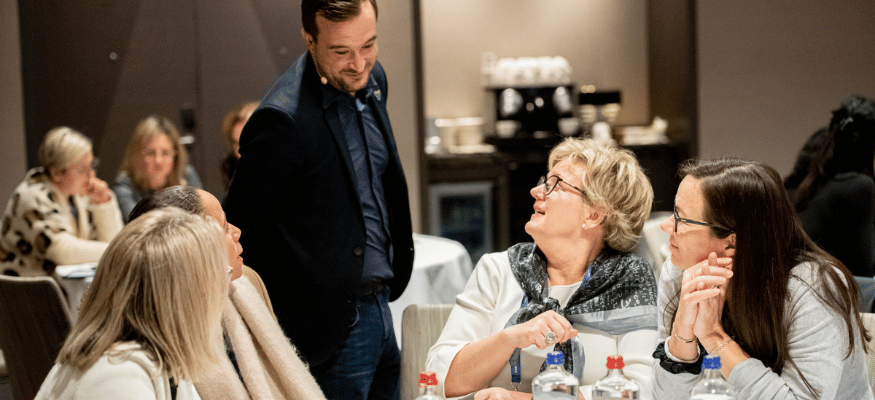


Attending a talent management conference in Europe has become an essential gathering point for HR professionals navigating a rapidly shifting landscape. At the Horizon Summit 2025, held in Amsterdam on 5–6 November, some of the continent’s most influential CHROs and people leaders gathered to confront a question that refuses to stay theoretical: how do you attract, develop, and retain the right people when the definition of “the right people” keeps changing?
Three sessions stood out for their direct relevance to anyone responsible for talent strategy. Together, they painted a picture of where talent management in Europe is heading — and what organisations that hesitate to adapt stand to lose.
The Talent Pipeline Problem No One Wants to Talk About
Nuno Cunha, Chief People Officer at Vetropack, opened a session on HR strategy for stakeholder value with a blunt admission: talent attraction in his industry was nearly impossible. Glass manufacturing involves temperatures of 45–60°C, extreme noise, and mandatory shift work. Younger workers, he noted, increasingly preferred careers like “YouTuber” over manufacturing roles. Meanwhile, an ageing workforce meant critical institutional knowledge was walking out the door — 5% of it already gone, with no university programmes teaching glass manufacturing to replenish the pipeline.
His solution was structural, not cosmetic. He implemented a dual-pillar strategy: internal HR excellence focused on competence, efficiency, and digitalisation, alongside an external customer value pillar that required every HR initiative to demonstrate a clear connection to business strategy and ROI.
He discussed key initiatives that deserved particular attention from talent leaders. First, the Talent Organisation Review (TOR), a systematic talent assessment programme that gave the company visibility into its people pipeline for the first time. Second, the Vetro Academy, a leadership development programme designed to ensure that promoted leaders actually drive the desired culture rather than merely inherit titles. Third, a rigorous strategic promotion process that evaluates behavioural alignment with company values — not just technical competence — as a non-negotiable criterion for advancement.
Cunha’s core message was that talent management in established organisations demands patience and persistence. In a company where employees have 40-plus years of tenure, habits die hard. But without systematic assessment, strategic development, and leadership accountability, no amount of employer branding will solve a pipeline problem rooted in organisational design.
Why Your Skills Strategy Might Be Failing Before It Starts
If Cunha’s session addressed who you hire and promote, the skills-focused sessions tackled what you develop in the people you already have — and why most organisations are getting the balance dangerously wrong.
Vlasta Rojkova, Global Head of Learning, Leadership and Wellbeing at Bekaert, presented what she called “The Skills Paradox.” Her argument was direct: organisations are facing a capacity crisis, not a skills crisis. She described a brilliant engineer colleague who was so exhausted she could not remember what she had learned the previous week. The problem is not a lack of training. The problem is that burned-out employees cannot absorb training in the first place.
The data she shared reinforces why this matters for anyone shaping talent management conference Europe agendas. Companies invest less than 10% of their learning budgets in human skills like empathy, collaboration, and emotional intelligence — the very capabilities that AI increases demand for — while over-investing in technical skills that machines will soon handle better. Burnout costs an estimated $300 billion globally in lost productivity and hits high performers hardest. One in three employees does not feel safe sharing ideas or asking questions, which means psychological safety remains a structural gap rather than a soft benefit.
Bekaert’s response was practical. They shortened meetings, introduced purposeful attendance policies, created Learning Fridays focused on wellbeing, and redesigned leadership training to emphasise psychological safety and energy management. The results were tangible: three consecutive years of increased employee engagement, higher psychological safety scores, and improved wellbeing metrics. The lesson for talent management professionals is that no skills framework will deliver if the humans you are trying to develop lack the capacity to learn.
On the skills architecture side, Arushi Acharya, Director of Learning and Talent Development from Stryker, shared the company’s journey toward skills-based talent management. Stryker’s challenges will sound familiar to many HR leaders: a leadership bench that needed strengthening, limited internal mobility visibility, and traditional hiring barriers that focused too heavily on titles and degrees. Their research indicated that 44% of core skills are expected to change by 2027 due to AI, robotics, and digital surgery advancements.
Rather than buying a pre-packaged solution, Stryker defined its own framework distinguishing between talent (intrinsic strengths), knowledge (learned information), and skills (practised abilities). They piloted with the marketing function, leveraged existing Workday infrastructure, and established a governance model with executive sponsorship. The vision was to democratise career advancement through transparent skill requirements, customised development paths, and integrated processes that connect hiring, development, and internal mobility into one coherent talent ecosystem.
What This Means for European Talent Leaders
These three sessions from the Horizon Summit 2025 point to a coherent direction for talent management in Europe. First, talent pipelines require systematic assessment and strategic promotion processes, not just employer branding campaigns. Second, skills development must be preceded by capacity building — wellbeing and psychological safety are preconditions for learning, not optional extras. Third, AI is not replacing the need for human competencies; it is amplifying it, demanding new capabilities like narrative intelligence and collaborative mindsets that most talent frameworks have not yet defined.
For HR leaders planning which talent management conferences in Europe to prioritise, the Horizon Summit demonstrated that the most valuable sessions are no longer about trend-spotting. They are about implementation — the messy, patient, structural work of redesigning how organisations identify, develop, and deploy their people in an era where the rules are being rewritten in real time.
The next Horizon Summit returns to Amsterdam in 2026. If the 2025 edition is any indication, the talent management conversation will have moved further and faster than most organisations are prepared for.